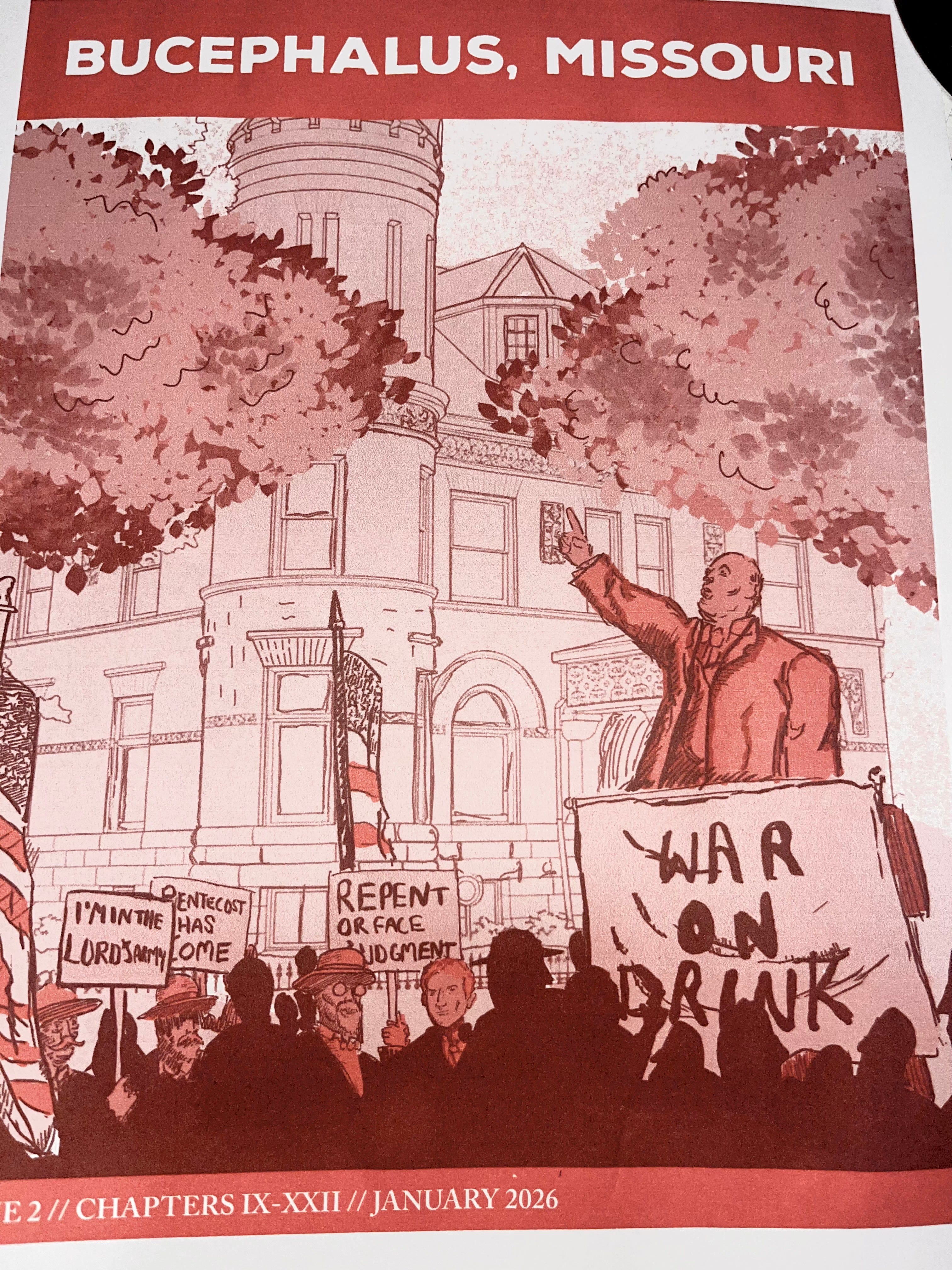
BUCEPHALUS, MISSOURI - ISSUE 2, CHAPTER 1

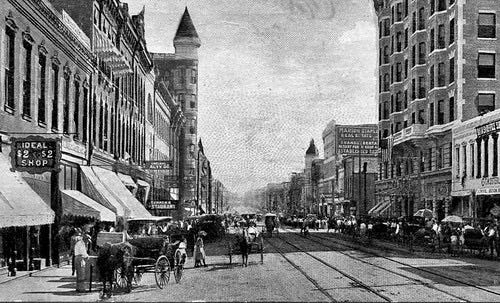
Herbert Judd and the old man walked back down the now nearly empty streets of Bucephalus, heading back to the offices of the Bucephalus Times-Democrat. The rambling street children and miners' wives had mostly all gone home, except for an unusually large crowd, bustling and shouting, circled around a huge man on the corner of the street.
The man was at least seven feet tall, bald, burly, and mustachioed like Judd’s image of an old-time circus strongman. He was batting off a herd of shabbily-dressed women waving dollar bills in his face and shouting.
“Ladies, ladies. One at a time. One at a time, please. I repeat. One at a time!” the big man shouted.
Turning and pointing at this bizarre display, Judd nudged General Sherman and asked “What is that, what is that man doing?”
“That, my boy, is the world’s third-oldest profession. After the harlot and the croupier comes the one hired by the wives and daughters to retrieve their men from the harlots and croupiers. You see, you’re well aware of the ownership of this fine establishment. It just so happens that Mister Auberry and now Auberry père are also the majority shareholders in United Southwest Lead and Zinc. Now, in order to secure the surety of both of these endeavours, going back to the days of The Count, all employees of the mining company have been paid in twenty-five cent increments at The Golden Horn. Now, five or ten dollars in quarters can get heavy for one man to carry home all the way out to the country where he and mother are staying, see. Now it just so happens that there is plenty of entertainment available at the Golden Horn which can lighten that load for you.”
“So, what’s this got to do with Hercules over there?” Judd asked.
“It’s simple. To make sure that the upstanding gentlemen of this city don’t waste their entire paychecks before its safe transport home, Kirby has set up an enterprise charging a dollar a head to retrieve men from The Golden Horn and send them back home with full pockets!”
“What’s his name?” Kirby asked an old woman in front of him as he inspected a one dollar bill up against the light.
“Harlow Schmidt,” she said.
“Harlow Schmidt. Harlow Schmidt. What’s he look like?” he asked.
“He has brown hair and chin whiskers but no moustache.” she said.
“How tall is he?”
“Oh, about my size. Maybe an inch bigger.”
“Does he bite?”
“What was that?”
“Does he bite? If I was to pick him up, would he bite me?”
“I don’t know if that man bites or not. Just git ‘im,” the woman said.
“Shall we stay and watch?” Judd asked General Sherman.
“No, son. Like I just said, we’ve got work to do.”
The two of them continued down the street, the one looking like a much older version of the other, or like a boy and his grandfather or great uncle walking home after the grandson or nephew’s twenty-first birthday. They dodged the late evening street car, crossing the broad street over to the other side, and under the awning of a stationery store where a young boy was sweeping.
“Good mo’ning mister General Sherman sir.” “And good evening, Frederick.” General Sherman said.
“I’ll be over right away with your paper, Mister General.”
“Thank you, son.” General Sherman said, then turning to Judd. “I pitch him an extra five dollars that he doesn’t have to share with his father to do special night deliveries to the office,”
“And I ‘ppreciate it!” the young boy said.
“Of course.”
They walked a little further down the road, and Judd asked the General “What is it we’re working on?”
“Well, I figure that we should begin our tale of this little hamlet at its very beginning,” General Sherman said. “I have procured a brand new tape recorder through my connections to the local radio station to ensure the accuracy of your transcription of my interview.”
“Is the tape recorder portable? It would be very useful in my field work as well!”
“Surely so, my boy. Just as long as that there field you’re in has a plug.”
The two of them reached the threshold of the Bucephalus Times-Democrat offices. Under his feet, Judd could hear the slow rumbling to life of the printing presses in the basement, a barely audible gurgling mechanical whirr. Just beyond the door sat General Sherman’s wife, Kate, furiously typing at the front desk with a massive stack of papers by her side. “Born eighteen forty eight. Died this sunday in the company of his loving l-o-v-i-n-g family. Flowers to be sent to, to. Oh, what is it. Let me see. Four-eighteen Pine Road. Great. Next. The Broward family is overjoyed to share the news of a birth of their first grandson, Giancarlo, G-i-a-n Carlo, the beautiful son of their daughter Hattie De Rossi and son-in-law Frederico De Rossi of Chicago.”
General Sherman and Judd passed her by on the way to the elevator, General Sherman patting his wife on the back as he went. They sat at the precipice of the elevator, Judd again tapping his foot to himself, the tune of Ode to Joy, a habit he picked up waiting in lines at Saint Louis stores and train stations in his youth. General Sherman began to sing, quietly, under his breath, “The old acquaintances he forgot, and never brought to mind” and hummed the rest, doing his best to keep up with the rhythm of Judd’s tapping foot. Judd thought about correcting General Sherman. His being seventy-five, or eighty, years old and educated as advertised at both the Mississippi Oxford and the English one, he should either on one hand be culturally erudite enough to know the difference between Beethoven and Auld Lang Syne when someone taps it as well as Judd did, or old enough to have sung Auld Lang Syne enough times, some seventy-four or seventy-nine times, to get at least the words right.
The elevator dinged and the two of them ascended up to the paper’s editorial offices. It was much quieter than earlier in the afternoon. The only clacking of typewriters that could be heard was the faint echo of Kate downstairs, that itself being nearly drowned out by the dull metallic rumbling of the presses below her.
“Into my office. My technician awaits our arrival,” General Sherman said.
They stepped into the office where a man just as old as General Sherman sat, a hulking machine sitting atop the General’s oak desk with all the papers. It was strange for Judd to see such an old man, the man from the radio station appearing only a few weeks younger than General Sherman himself.
“Franklin, my friend! Good to see you as always!”
“General, sir,” said the other old man, stretching out his hand to both Judd and General Sherman.
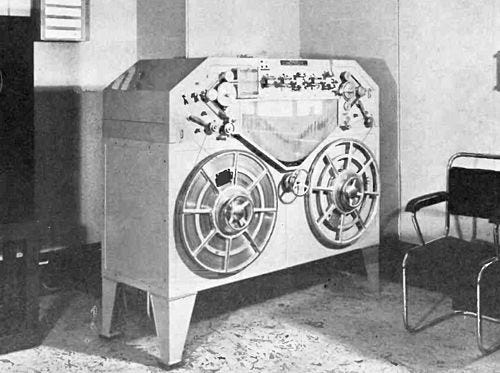
“Alright boys,” Franklin continued, “let me get this thing a’rollin’ and we can begin.” He jiggled a few cables and flipped a switch on the machine, which emitted a soft windlike sound as it wound the magnetic tape around its spools.
“Now, where shall I begin?” General Sherman mused to himself, as loudly as he could into the conical microphone protruding out of the machine. Judd began to produce the notebook and pen from his sack but was interrupted by General Sherman mid-musing, “Now that won’t be necessary son. We’ve plenty of typists here that can transcribe this recording directly from a record for you.”
“Well, General, you’ll have to press it first. Tell you what, son. Come see me at the station after my one o’clock show. I’ll press it fer ya and you’ll be grand. There’s plenty of folks you can talk to for your book there too.”
Before Judd could even ask the General his first interview question, General Sherman launched into his dramatic retelling of the tall tales and more academic accounting of Bucephalus’s history. In spite of his age, the old man continued ceaselessly, without even seeming to take a spare breath, to narrate each step of the town on its journey from untamed wilderness to hole in the ground to thriving mining community. Each iterative chapter in this tale involved winding multi-minute anecdotes about this or that personage in the annals of early Bucephalus history, up to the point where Franklin intervened, saying “Got to load in more tape, General.”
Franklin toyed with the tape recorder for fifteen minutes, Judd amused the whole time by the image of a man so countrified working on such an advanced machine. Then, he finally got the tape mounted and jiggled the cables and flipped the switch again, and off went General Sherman. The interlude provided time for General Sherman to ponder his own special Philosophy of History. Of course the Count was bound to be superseded in turn by the railroad types, his mode of wielding power was too old world. Of course in turn they were supplanted by the likes of Auberry because Bucephalus, after all, is nominally the South, and the South can only ever be governed by crooks until the great betrayal of seventy-seven is undone and so on.
This exposition on the rising and falling of individual stars in the constellation of Bucephalite (Judd had finally settled on a proper demonym for the town’s residents and denizens) history was interrupted by crashing and clanging outside of General’s door.
“What in the world is that!? Cut the tape!” The General said, springing up from his chair with unusual vigor and peaking his head out the door.
Michael stood at his drawing desk, nearly tearing it apart, flinging pens and brushes across the room.
“Sunofabitch, sunofabitch, sunofabitch. Now where do I keep my can of good coffee,” he drunkenly mumbled to himself.
“General!” he yelled “General, sir! I still need to,” he hiccuped “draw Herbie’s staff portrait! Herbie Herbert Judd! Are you in there? Get out here so I can draw yer piture!”
General Sherman stepped out of his office and said in the same haughty paternalistic tone he’d employed on Judd, Vincent, and Michael at The Golden Horn two hours earlier, “Mister Judd needs to rest, young Michael. After all, by his time, it’s nigh on two o’clock in the morning!”
“Alright. I’ll save it fer tomorrow. I’ll be fresh then. I’ll see you General,” Michael said, this time much clearer and in hushed tones, gently reassembling his drawing table as General Sherman bid Franklin farewell and showed Judd to his temporary quarters.
“I’ll see you at the station tomorrah, son,” Franklin said. “Don’t forget to ask the girl for Uncle Frankie. I’ll even have her type up this tape for you!”
“Appreciate your time, Judd said.
He was exhausted now that the distractions of work, then carousing, then working some more had worn off. He stepped into the refitted supply closet adjacent to General Sherman’s office, and fell onto the cot that Kate had set up for him while he was away. He drifted to sleep to the sounds of General Sherman and Kate both critiquing the proofs of that morning’s papers.
IN THE NEXT CHAPTER, READ THE FULL TRANSCRIPT OF GENERAL SHERMAN’S ACCOUNT OF EARLY BUCEPHALUS HISTORY
This is the first chapter of Issue 2 of BUCEPHALUS MISSOURI, a pulp magazine illustrated in comic book style by me, retelling Herbert Judd’s construction of a history of the small Ozarks city for the Federal Writers Project. To read issue 1, click here, as all physical copies are sold! To support the ongoing production of issue 2, click below:
BUCEPHALUS ISSUE 2 EARLY SUPPORTER PACKAGE