
BUCEPHALUS, MISSOURI
A Novelistic History of The Missouri Ozarks 1869-2010

Good morning, my long-lost substack subscribers,
This is just a quick message to say that my writing has migrated over to a new site for my long-term writing project, a novel covering the history of a town in Southwest Missouri, beginning with the research of WPA Writers Project member Herbert Judd. In the stories that I had published on this venue long ago (all now retroactively taking place in Bucephalus and its nearabouts, although I won’t repost them until after they undergo severe editing), I had begun to flesh out what and where Bucephalus, Missouri actually was, but due to my own limitations at that time, the actual project did not begin in full until the winter of 2024.
The goal in undertaking this project is to give as full of a picture of the Southwest Missouri Ozarks as I possibly can from the years 1870 to more or less the present day, taking as long as needs be. Each new episode will be available every monday, usually in the morning CST.
Click here to go to the new site!
Preview of the first chapter from the new site:
PRELUDE – EXCERPT FROM THE W.P.A GUIDE TO MISSOURI (1940)
BUCEPHALUS (1100 alt, 36,500 population) was founded upon the dream of one man and the immense wealth of the earth he landed on, is the center of Southwest Missouri’s Lead and Zinc mining belt which stretches along a 30 mile circle from Galena Kansas to the southern foothills of the Ozark Mountains in Northern Arkansas. Although girded by the immense mineral wealth of its land,
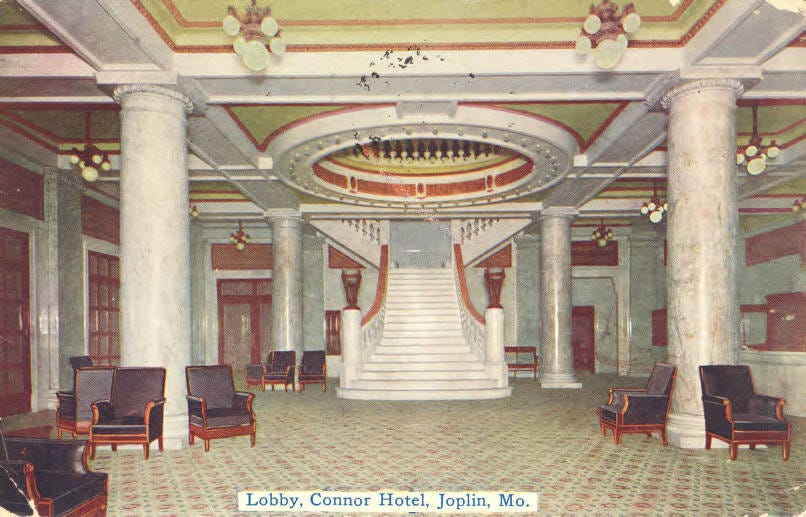
In its infancy a town known equally for its saloons, gambling rooms, and picture shows as for its capacity to make a man rich, the town’s main streets are now painted with the conventional hustle and bustle of any prosperous middle-western town. With the exception of an outlandish, neoclassical, stone-white building, once known as “The Golden Horn” and famous for its saloon and gambling tables, ramshackle constructions dating from the boom days of the 1870’s, most of the structures have been built since 1900.
Except for a small area of substantial homes in the Eastmoreland district centering about Fifteenth Street, East Town is a section of smaller residences. Broadway, the original business thoroughfare, still contains a few of the narrow brick and frame buildings and residences of days long past. Close to the business district live the majority of the Negroes who compose 6.2 per cent of Bucephalus population, a considerable number of foreign-born, mostly Greeks and Italians who make up 10 per cent of the inhabitants. In the area where early “close-in” mining was conducted, the houses are small and shabby. Beyond this district, they appear increasingly prosperous.
The story of Bucephalus is the story of its industrious founder, one Mr. (or according to other variations of local myth, Count) Demetrius Ypsilantis-Comnene-Paleologue, a man of Corsica of Greek extraction. Count Ypsilantis-Comnene-Paleologue was born during the age of the great revolutions which shook the foundations of his home continent, in 1821, the same year in which both his father and his hero, Lord Byron, fell on the battlefield chasing their respective aspirations for the Greek Throne.
Local legend tells of a story of the count shaking the young Emperor Louis-Napoleon III’s hand at a secret meeting of Italian ‘Carbonari’ revolutionists in the early 1840s. His would-be revolutionist streak was cut short by his business career, by the age of twenty-five, becoming the chief arms dealer to both the Sublime Porte and the Russian Tsars at the same time, all from a shabby one-room office in the Phanariote quarter of Constantinople. The Count was forced stateside during the Crimean War, though, when the agents of the Tsar and the Sultan caught wind of his double-dealing and organized a mob to chase him out of town, sending him barreling over the Atlantic first to New York City, where he set up shop in Brooklyn in the import business.
The import business then again became the arms business with the outbreak of the War of Secession in 1861, where Count Ypsilantis, in the spirit of Brotherly Freedom and Emancipation, dropped the ‘count’ from his name and began a risky business of smuggling arms to pro-Union guerrillas behind Dixie lines. For this, it is said, The Count received a special in-person commendation from Lincoln himself in the form of a deed to the land known now as “The Count’s Manor” a sprawling expropriated plantation home formerly owned by the rebel governor of Missouri and colonel in Lee’s Army. With the end of the war, The Count decided to begin his enterprise of settling the land supposedly issued to him during that second encounter with a great personage of history, and brought with him fifty other Greek and Italian expatriates to turn that shabby stretch of Ozark highland into a model Athens an ocean away.
The Greeks renamed this stretch of land from “Baker’s Pasture,” the name given to it by that dispossessed Confederate colonel, to “Bucephalus” in honor of Alexander’s great conquering steed. Within weeks of cresting the great Ozark mountains and landing in the plains below, The Count’s men stumbled upon what would soon become the town’s great mines. In the process of digging the trenches, which were to be filled to become cobbled streets, one of The Count’s retinue, an Italian by the name of Alessandro Pavolicini, discovered one of the biggest deposits of lead ore in the entirety of these United States. From there, the settlement’s self-styled Mayor, The Count, could not control the runaway growth of his creation. Plans for a great European style system of avenues and byways were soon replaced by the traditional layout of all the great boom towns of the West of its time. He used the funds he planned to use to build a university to build a saloon, The Golden Horn, named in honor of his lost home. Using his share of the revenues from the mines (which he co-owned with his friend Pavolicini) and gambling revenue from his saloon, The Count became the whole middle west’s greatest patron of the arts, funding the city’s first library and in the last years of his life, a teacher’s college in between the saloons and general stores which pop up in such a town as it grows.